Celladon at BioCEO 2015: A Tough Proposition

Sometimes reiteration makes tasks look harder.

Celladon recently reiterated the case for Mydicar, their AAV1-SERCA2A therapy for patients with heart failure with reduced ejection fraction (HFrEF), at the BioCEO gathering. Celladon has come to prominence based on a subgroup analysis of their CUPID1 trial, wherein the Mydicar high dose arm (n=9) showed statistically significant improvement over the placebo arm (n=14). Although some are convinced by this study result, I’ve expressed my skepticism in an earlier post. Unfortunately the recent presentation makes the Mydicar proposition look less likely to succeed.

In the earlier piece, I’d highlighted strong reasons to question the degree of cardiomyocyte transduction and SERCA2A expression induced by Mydicar therapy. Celladon’s CEO was much more upbeat at BioCEO, describing the administration as one that results in “homogenous uptake” resulting in SERCA2A being expressed “for the life of the cell.” Perhaps that’s a form of confidence in the product. Unfortunately, their data to date provide little support for such unequivocal claims. The discrepancy between the presented scientific data and the company’s claim can be a red flag in and of itself: it is one thing to be confident in your program, but it is more effective if that confidence isn’t accompanied by claims that seem to be undermined by your own published data.

Rather than getting bogged down in the details of the AAV1 mechanism and SERCA2A protein expression, another way to assess this program is to examine the upcoming clinical trial expectations and compare them to historical observations. Celladon is currently running CUPID2, their sequential follow-up to CUPID1. CUPID2 is placebo controlled and enrolling 250 patients (~86% NYHA Class III/IV) split evenly into two arms. Participants will receive the high dose of Mydicar that resulted in statistically significant improvement for 9 patients in CUPID1 compared to their 14 placebo / best available care comparators. In this subgroup analysis, CUPID1 demonstrated an 88% risk reduction. That’s a very large number, especially when compared to our current and upcoming standards of care. To note:

  1. Beta-blockers provided a 19% risk reduction in a HFrEF population that was ~60% NYHA class III/IV
  2. LCZ696, the new offering from Novartis, provided a 20% risk reduction in a HFrEF population that was ~30% NYHA class III/IV

In these multi-thousand patient trials, two drugs, one a mainstay and the other a hopeful newcomer to heart failure treatment, have shown ~20% risk reductions. The trials did not enroll identical patient populations, but nonetheless the risk reduction percentages are eerily similar. In that light, CUPID1’s 88% risk reduction can either appear stellar, or more convincingly a fluke event. It is hard to imagine that this treatment will come out with a risk reduction that is four times those observed in these large trials. This is especially difficult to reconcile since we know that the SERCA2A mechanism of action overlaps with the beta-blocker mechanism of action. In fact, preclinical models have demonstrated that beta-blocker treatment can restore low SERCA2A expression, which is Mydicar’s raison d’etre. If beta-blockers, within their broader mechanism of action, increase SERCA2A expression the way Mydicar is proposed to, is it reasonable to expect that Mydicar demonstrate a risk reduction that is twice as large as that for beta-blockers?

It is not controversial to state that the risk reductions in larger trials tend to be smaller than those in earlier, smaller, proof-of-concept trials. Celladon’s design of the currently running CUPID2 trial suggests that they’re aware of this contributing factor, as the trial was designed to have 83% power to detect a 45 percent risk reduction. This is a more modest target, and the results are due in April, 2015. The company concedes that they need a p value significantly less than 0.05 to make this trial the primary basis of approval. At the same time, the company appears to concede that CUPID2, in and of itself, is unlikely to support registration. They note that a follow-on trial, CUPID3, is under planning and will be used as a phase 3 or phase 4 trial, depending on CUPID2 results and their conversations with US and European regulators.

In effect, for CUPID2 to form the primary basis for registration of Mydicar, the 250 patient trial needs to have an outcome that would come close to replicating the 80%+ risk reduction seen in a 23 patient subgroup analysis. That is a tall order for any drug.

 

Cardio3 and The Biotech Pivot

Precision curative care.

That was the early slogan delivered at the Cardio3 Investor Day on January 30, 2015. It can be hard to limit cynicism when buzzwords (precision), dubious promises (curative) and supposed empathy (care) are trotted out and put on display for prospective investors.

Cardio3’s lead treatment is C-Cure, an autologous cell therapy for heart failure. The method depends on a bone marrow harvest, followed by isolation of a limited progenitor cell population called mesenchymal stem cells. These cells are subsequently treated with a cocktail of factors to induce them into a “cardiopoietic” cell population that, per preclinical results, more effectively benefits the heart by presumably differentiating into cardiomyocytes and using paracrine effects to promote differentiation of endogenous stem cell populations in the heart. This is a more limited population compared to the crude bone marrow mononuclear cell preparations that have convincingly failed in human clinical trials.

This cell therapy preparation is planned to be tested in two phase III trials, named Chart-1 and Chart-2, that are primarily based in the EU and the US, respectively. The precursor phase II trial, the C-Cure trial, ostensibly showed an improvement in left ventricular ejection fraction (LVEF) in a randomized setting, rationalizing the company’s decision to move forward. That said, there are some factors to consider when appraising Cardio3’s chance of success in heart failure.


Perhaps the largest factor in assessing the chance of phase III success is to examine the underlying phase II data. In the case of the C-Cure trial, there were some concerns in the publication expressed by third parties, culminating in a formal reply by the authors. But regardless of reporting inconsistencies, one factor about the C-Cure trial is consistent: the company made clear in the Investor Day presentation that the outcome of the trial was successful. Perhaps a number was mistakenly reported in one location or an aspect of the protocol was not immediately clear when reported, but when all is clarified, the trial is presented as a successful phase II. This is an important point because the C-Cure method is labour intensive, and success with such a complex product should be respected. Each patient randomized into the treatment arm undergoes a bone marrow aspiration to start the process of producing the 6-700x10E6 cells that is re-injected into the patient’s heart. 

Unfortunately, this is perhaps the biggest flag when appraising the phase II data. The results reported by Cardio3 were not presented on an intent-to-treat (ITT) basis. In other words, patients for whom the cell preparation could not be successfully completed were removed from the analysis, effectively making it a per-protocol analysis. This type of analysis can be meaningful for early stages of product development as efficacy signs are looked for in a process that continues to be streamlined and perfected. Nonetheless, for subsequent phase III trials, an ITT population will be the major focus of regulators. For the C-Cure trial, of the 32 patients randomized into the cell therapy arm, 7 patients were subsequently excluded due to the cell collection / expansion process being suboptimal. Along with a few other exclusions for different reasons, only 21 of the 32 patients on the cell therapy arm made it to the per-protocol endpoint.

In short, a phase II trial wherein only 21 of the 32 ITT patients were included in the efficacy analysis on a per-protocol basis ends up on weaker footing than if the efficacy analysis was completed on an ITT basis. This argument isn’t novel, and is in fact noted by an accompanying editorial on the C-Cure trial results. Given the complexity of the cell harvesting and expansion process, it is not unreasonable to expect that Cardio3 will face similar challenges in their registrational phase III trials. However, they are unlikely to convince regulators if they deviate away from an ITT trial analysis. All told, there is reason to be highly cautious of extrapolating the C-Cure results into expectations for Chart-1 and -2.

And perhaps the company feels the same way. Chart-1, the EU-focused trial, has practically completed enrollment. An interim analysis is due in March, 2015, wherein the DSMB will render one of three opinions:

  1. Continue the trial as is
  2. Continue the trial but expand enrollment, as the DSMB signals that an aspect of the trial may need more patients to achieve adequate power
  3. Stop the trial due to clear safety signals or clear lack of efficacy

Outcome #3 is clearly negative. Outcome #2 is very likely a negative sign as well. Expansion of enrollment suggests that the assumptions going into the trial are incorrect, and history has shown that this is usually not a positive occurrence for phase III trials. Outcome #1 is likely neutral and doesn’t denote likely success or failure, simply ruling out overwhelming efficacy or overwhelming toxicity.


With Chart-1 setting itself up for an interim analysis in March, 2015, Chart-2 then stands in a curious place. The company was on record, and the CEO confirmed, that initial guidance had Chart-2 enrolling its first patient by the end of calendar year 2014. That has been pushed back. The claim is that the interactions with the FDA are the cause, specifically a change in the primary endpoint of the trial. Curious. Perhaps this timing gives outsiders a view into the confidence expressed by the company. By pushing back patient enrollment, Cardio3 will likely take in the outcome of the March 2015 DSMB recommendation for Chart-1 prior to actual patient enrollment in Chart-2. It would be reasonable to say that this is a prudent move; however, it would also be fair to say that the confidence in the phase II data is not unwavering.

Coincidentally, approximately half of the Investor’s Day presentation was focused on the company’s recent foray into the CAR-T space. This is definitely a burgeoning area for oncology, with multiple companies and academic institutions taking dedicated steps to develop these treatments. Therefore, it does come as a surprise to see a company called Cardio3 slowly morph into an equal part oncology company. Again, perhaps this is prudent by management. However, long term followers of biotechnology companies will recognize this as the possible first move in a classic Biotech Pivot (Tm). The rules of the Biotech Pivot state that as the day of judgment nears on your lead product, mentions of other pipeline efforts shall increase.


So is Cardio3 executing the Biotech Pivot? Or is this simply prudent management by an experienced team? A prediction is that the March 2015 analysis is benign and that the company continues Chart-1 as is and that Chart-2 enrollment is extremely slow for the first half of 2015. And, luckily for investors, there will be plenty of talk on the CAR-T side to keep them busy... or distracted.

Gene Therapy For The Heart - The SERCA Example

The push behind gene therapy for the heart is gaining strength alongside efforts to develop cell-mediated therapies to induce cardiomyocyte repair and regeneration (commented previously). Gene therapy strategies, particularly those based on viral vectors such as the adenoassociated virus (AAV) are attractive due to their relative ease of preparation and administration in preclinical models. One of the furthest along is AAV-mediated delivery of the sarco/endoplasmic reticulum Ca2+ ATPase pump (SERCA) for the treatment of heart failure.


The premise behind this approach lies in the observation that preclinical models of heart disease demonstrate a reduction in SERCA expression. Consequently, decreased SERCA activity in the cardiomyocytes may reduce the uptake of Ca2+ into the sarcoplasmic reticulum, and may therefore allow abnormal Ca2+ levels to persist during the cardiomyocyte’s Ca2+ oscillations. This may have implications for contractile activation / relaxation of the heart, and may even help to provoke a pro-hypertrophic response. The administration of an AAV encoding SERCA aims to counter these deleterious events by raising SERCA levels back to normal physiological levels.


To reasonably restore physiological SERCA function through AAV-mediated expression, it is instructive to keep in mind the basic and necessary steps of the AAV-mediated gene therapy paradigm. For the AAV-mediated therapy to have a reasonable chance at success, three general steps are requisites before we can reasonably hope to see clinical efficacy:


1. Inject virus at a dose sufficient to transduce the target organ

2. Assure that the virus meaningfully transduces the target organ

3. Check for *protein* expression in the target organ of interest


In regards to step 1: It is important to note that these are replication defective viral therapies. In that regard, there will be a proportionality between the target number of cells to be transfected and the viral dose. In simpler terms, the dose of virus required to meaningfully and reliably transduce a mouse heart will not be sufficient for equal transduction of a larger rat heart. Therefore, as we increase size of the target organ, the viral dose has to increase, thereby necessitating a scaling-up of doses as we move from mice to humans. Below is a graph showing the maximum viral genomes injected per gram of typical heart weight for the AAV-SERCA construct used by Celladon in clinical trials as well as the antecedent preclinical studies:


Arguably, there isn’t significant difference in dosing at the various stages. These data suggest that, given equal tropism of the virus for the heart across species, the dosing may be sufficient. Arguably, dosing in the preclinical sheep model was the highest, and would therefore give the best corollary for assessing the sufficiency of dosing in the clinic.


This allows us to move onto Step 2 and attempt to address the ability of the virus to transduce the target organ of interest. The most complete set of data provided in the available preclinical literature is from the sheep model described by Byrne et al. For an intracoronary dose of 2.5x10E13 viral genomes, they note the detection of an average of 1651 copies per ug of DNA from the heart, but that only 3 of the 6 injected animals had any detectable copies. In other words, 3 of 6 animals had no detectable persistence of the AAV, and of the 3 that did, they averaged 1651 copies per ug of DNA. For the liver and lung from these animals, they indicated the detection of 148773 copies and 7781 copies per ug of DNA, respectively. In essence, the data suggest that a minority of the injected AAV persists in the heart, if at all. Therefore, with respect to the targeting of the injected AAV to the intended organ, the preclinical sheep data imply that a significant challenge remains. If we assume that only the heart, lung and liver had detectable AAV and that they’re identically sized organs (Footnote 1), it would suggest an upper boundary of ~1% of the injected intracoronary dose targeted to the heart.


Nonetheless, the low level of AAV presence in the heart may be immaterial if a significant increase in SERCA protein can be demonstrated. To best address Step 3, we can examine the publication by Byrne et al to see if there are data provided for protein expression. Unfortunately, no Western blot data are provided. There is a vague indication about mRNA expression in the intracoronary versus intracoronorary + recirculation group, but it only indicates the degree of increase with recirculation versus without. Plus, mRNA expression does not guarantee protein expression, and without protein expression no therapeutic benefit can be expected or rationalized. However, given that only 3 of 6 animals receiving intracoronary injection of 2.5x10E13 viral genomes showed any persistence of the AAV whatsoever, we can safely assume that 50% of these animals had no increase in SERCA protein expression.


But what about the remaining 3 animals from the high dose intracoronary group? Absent explicit data from the authors, we can try to determine whether the resident viral genomes are present in sufficient number to elicit sufficient transcription / translation to increase SERCA protein levels. For these 3 animals, it was noted that they averaged 1651 copies of the AAV per ug of DNA. Therefore:


  • Convert the mass of DNA to mol basepairs: 1 ug DNA / (660 g/mol basepairs) = 1.52x10E-9 mol basepairs of DNA
  • Convert the mol of DNA bp into number of bp: 1.52 x 10⁻⁹ mol DNA bp * 6.02x10E23 basepairs/mol = 9.12x10E14 basepairs
  • Convert the number of basepairs into copies of the genome: For this step, we ride the assumption that the human genome is ~3x10^9 bp, meaning that 9.12x10^14 bp / (3x10^9 bp per genome) = 3.04x10E5 genomes.


Put simply, their test surveyed an equivalent of 304000 copies of the genome. Within those 304000 copies, 1651 copies of the exogenous AAV DNA were found. In other words, there were ~302350 copies of the endogenous SERCA gene and 1651 copies of the exogenously introduced SERCA. Therefore, the exogenous AAV-SERCA was responsible for increasing SERCA copies by ~0.5% over the amount endogenously present. Unfortunately, the clinical data does not appear to improve on the data from the preclinical sheep model. Szebo et al note that the highest level was 561 copies per ug of DNA assay from Patient ID 091007 (Table 3). Given similar calculations, that suggests an approximately 0.2% overexpression above endogenous levels. Suffice to say, that is not a large level of expression above and beyond what is already endogenously present.


The above calculations give us some insight into the consideration in Step 3: is there an increase in SERCA protein expression in the target organ of interest? The calculations regarding persistence of the AAV-SERCA would suggest that noticeable protein overexpression is unlikely. Therefore, we can comb through the preclinical work in rats, swine and sheep to determine if there is a consistent and reliable demonstration of increased SERCA protein in the heart of AAV transduced animals.


Sakata et al suggest increased AAV-mediated SERCA expression in a rat model of aortic banding (Fig. 4). However, there are no numerical data provided to document the extent or significance of overexpression, which is visually not striking. Further, a contemporaneous control using an AAV encoding for parvalbumin shows striking overexpression of parvalbumin protein, making the claimed SERCA overexpression appear modest, if at all significant. A thematically overlapping paper by the same group suggests a doubling of SERCA protein expression in the rat.


Moving to larger animals, a subsequent paper using a swine model suggests an increase in protein expression following AAV-SERCA administration in the heart failure group when compared to the saline treated heart failure group. Comparing the SERCA protein level in the AAV treated heart failure group to the normal, nonfailing group demonstrated no SERCA protein overexpression. Interestingly, these data are provided in bar graph form (Fig. 4) but are the only bar graphs in the manuscript that do not have error bars. In the sheep study reported by Byrne et al, no protein data are offered.


To be fair, Byrne et al note:


“Nevertheless, the positive functional effect of AAV2/1SERCA is entirely consistent with previous work that shows SERCA2a is a low-abundance gene and that only one to two functional copies are required per cell to maintain normal levels of SERCA mRNA and protein.”


This suggests that very little overexpression can have a significant functional impact. In that regard, it is important to note that the sheep receiving 2.5x10E13 viral genomes of AAV-SERCA by intracoronary infusion did not show improvement over control in any of the remodeling or functional parameters presented including left ventricular internal diameter (Fig. 2), change in fractional shortening or ejection fraction (Fig. 3), or positive or negative dP/dt (Fig. 4). Therefore, the low level of persistence for 2.5x10E13 viral genomes of AAV-SERCA administered through the intracoronary route in sheep did not translate into a functional benefit as presented, suggesting that the cited low threshold of expression required to restore normal SERCA protein was not exceeded.


All told, the high dose of 1x10E13 viral genomes administered in the trials to date by Celladon provide limited corroborating data to support the hypothesis that the functional outcomes are a result of AAV-mediated increases in myocardial SERCA expression. Although the CUPID clinical trial demonstrated a benefit for the 1x10E13 viral genome high dose group versus placebo, it is reasonable to ask, given the low level of persistence of the AAV-SERCA construct and scant data for increased SERCA protein expression, exactly what is the mechanism driving this benefit? The calculations and observations based on the preclinical models do not provide a consistent line of evidence for AAV-SERCA driven benefit. The ongoing CUPID2b study, administering 1x10E13 viral genomes via intracoronary route, will determine whether the functional outcomes in CUPID1 were reflective of the technology or a fortuitous coincidence within this patient group.


Footnote 1: The assumption that the heart, lung and liver are the same size benefits the calculations in favour of the heart. In fact, the liver is 4-5x larger by mass (~1.5 kg) and the lungs 2-3x larger by mass (~800 g) as per data here and here.

Information Overload

Investors in biotechnology companies follow their investments closely. Therefore, they appreciate the knowledge that a clinical trial, previously announced by management to be in planning, is now actually up and running. That’s a tangible milestone and allows investors to better formulate their perception of a management team’s ability to execute.


But then, sometimes, one meaningful press release can turn into a dozen. Or can it? Consider the time line of Cardio3 and the opening of their European phase 3 trial, Chart 1.


November 22, 2012 - Cardio3 announces opening of Chart 1.

And there was much rejoicing.


June 10, 2013 - Cardio3 announces treatment of first patient in Chart 1.

Ok. It is one thing to establish the protocol and organization of the clinical trial, and now we get confirmation that an actual patient has been enrolled. It is appreciated. Thank you. Now go out there and execute execute execute!


September 30, 2013 - Cardio3 announces world’s first phase 3 trial in regenerative medicine for heart failure… in Spain.

Hmm… wait, is this another trial? In this short time did they manage to open another trial apart from Chart 1? Well, no. Chart 1 now has the occasion to enroll eligible patients in Spain.


October 23, 2013 - Cardio3 announces that Chart 1 can now enroll patients in Italy.

Surely they’re not going to announce the opening of a center in each and every new country under the jurisdiction of the EMA?


November 12, 2013 - Cardio3 announces, among other things, that Chart 1 can now enroll patients in Poland.

Maybe we are. And don’t call us Shirley.


April 10, 2014 - Cardio3 announces that Chart 1 can now enroll patients in Ireland.

Fair play. These lads are sound.


June 10, 2014 - Cardio3 announces that Chart 1 can now enroll patients in Sweden.

Heja Sverige! *


October 13, 2013 - Cardio3 announces that Chart 1 can now enroll patients in Switzerland.

Watch your back, Novartis.


One can reasonably argue whether all of these PRs were needed. Cardio3 do make tangible announcements of the trial being 50% enrolled as well as 100% enrolled. But it is reasonable to ask the company what the significance was of each of these territorial openings? Maybe. Maybe not.


And sometimes, fluffy PRs aren’t limited to trial site openings. To wit:


March 26, 2014 - Cardio3 announces that their investigational therapy was mentioned in a review published in Nature Reviews Cardiology.

This is great. You always want independent recognition of your work within the community. But wait. Could it be that one of those authors once worked at Cardio3? Could it be that two of those authors, at one point in time, were noted to have financial interest tied to Cardio3? To be fair, one of the authors of that review appears to have appreciated the work of Cardio3 so much that he has worked hard to take the horns and help the company execute another of its trials, this time in the US (warning, pdf link!). The authors of the manuscript explicitly state that they have no competing interests. I take them at their word.


April 7, 2014 - Cardio3 announces that their regenerative technology was recently highlighted in an editorial.

Again, very good news. But… huh. Those names look familiar.


October 8, 2014 - Cardio3 announce a research and development collaboration.

Details here (again, pdf link). Something in there sounds familiar.


In short, it is always interesting to watch the operation of companies from the outside. It can be like a game of Clue, and some companies put out more red herrings than material pieces of information. And sometimes, the pieces of information lack full context. Nonetheless, it’s a fun game for investors to play.


* Apologies to native Swedish speakers. I stole this from the internet in the hopes that it is in correct context.

Source: http://www.ozgurogut.com/thoughts/2015/1/1...

Notes From The Incyte Presentation At The 2015 JP Morgan Conference

Some highlights from the recent update by Herve Hoppenot at the JP Morgan Healthcare Conference:


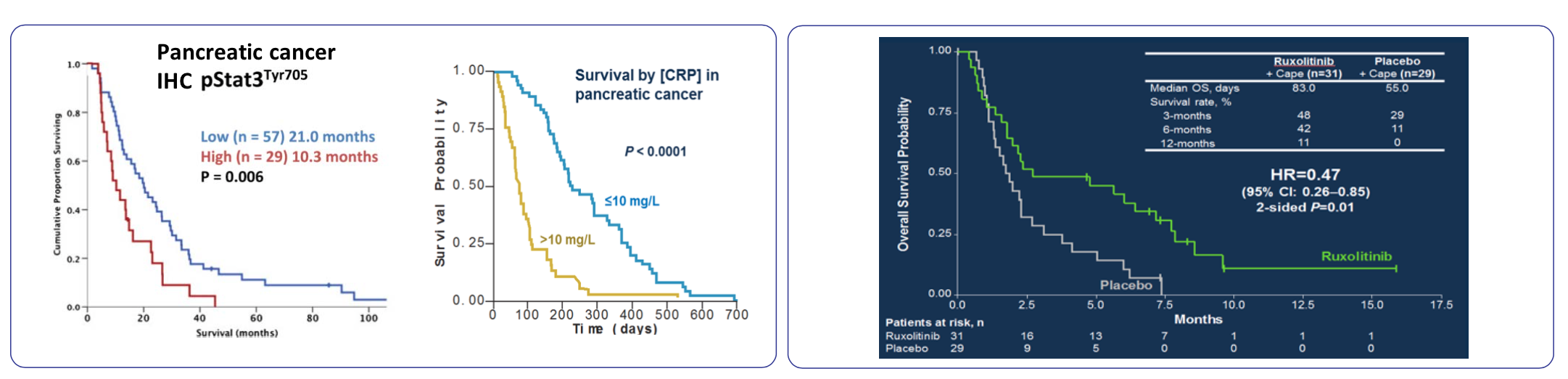
- The company anticipates results from the Janus 1 and 2 trials to be available in 2016. As a recap, these trials are focusing on the use of ruxolitinib with capecitabine in patients at different stages of pancreatic cancer. These trails are pursuing a prespecified patient population based on the exploratory phase 2 data suggesting a relationship between CRP and ruxolitinib treatment. Whether that relationship is causal or correlative yet unrelated remains to be seen. Typically, markers such as CRP are reliably indicative of disease but have not been great prognostic companions for treatment subgroups.


- The controlled phase 2 trials of combination ruxolitinib therapy in colorectal, nonsmall cell lung and breast cancers continue. Data are expected in 2016.


- In an attempt to protect / expand their lead in the JAK space, the company is pursuing development of its selective JAK1 inhibitors, INCB39110 and 52793. The latter is the newer addition to the clinic and, compared to 39110, has ~5x the increased selectivity for JAK1 vs JAK2. The rationale behind this is to minimize the JAK2 inhibition of a mixed JAK1/2 inhibitor like ruxolitinib, thereby attempting to minimize myelosuppression. INCB39110 is already in the clinic in combination studies for nonsmall cell lung and pancreatic cancers. The more interesting INCB39110 trial is in B-cell malignancies where it is being tested in combination with Incyte’s internal PI3Kd inhibitor INCB40093. The newer molecule, INCB52793, is just entering dose finding phase I studies.


- Addressing the recent Agenus deal, the message was as I suspected: this is mostly a tools deal. Incyte believe that their internal engine is strong on the small molecule front, but they see a relative weakness in biologics. The Agenus platform will allow them to screen for fully humanized antibodies against targets of their choosing. Not too surprising, since biologics are a very relevant and meaningful platform and Incyte had not yet shown much acumen in this regard.


- On the PI3Kd front, Incyte has two candidates: INCB40093 and a more recent compound, INCB50465. The latter compound is roughly an order of magnitude more potent in preclinical assays. However, the benefit of this increased potency is unclear. Interestingly, although their slide deck showed preclinical data rationalizing the combination of INCB40093 and INCB39110, no such data were shown for INCB50465. Therefore, it remains uncertain if the increased potency has a material benefit in either combination or monotherapy use.

Screen Shot 2015-01-13 at 12.49.44 PM.png


- Two new molecules, INCB54828 and 54329 are FGFR and bromodomain inhibitors (see this link for a general background), respectively. For INCB54828, no data were broken down for its relative selectivity among FGFR1, 2 or 3. For the bromodomain inhibitor, the requisite mouse model data were shown… but as usual, such data are necessary for advancement but not overly useful in predicting clinical efficacy. These compounds do appear to be moving ahead, however, as the bromodomain inhibitor was noted as entering the clinic imminently.


- A wild card for Incyte this year will be the rheumatoid arthritis program. The first phase 3 readout occurred late last year and was positive. Readouts for the remaining 3 trials are expected this year, and of particular interest to me is the RA-BEAM trial that will  include structural endpoints and include Humira as a comparator. The biologic market for RA is very large, but to date the small molecule competitor, Xeljanz (tofacitinib), has not made much of a dent. I think Incyte’s baricitinib has advantages over Pfizer’s tofacitinib, with the latter being a JAK3 inhibitor and the former a mixed JAK1/2. Cross-talk between JAK1 and 3 is possible, and I think a slight safety advantage may emerge for baricitinib versus tofacitinib. Whether this combination of efficacy and safety makes a dent on biologics remains to be seen. My suspicion is that it does not in the near term (1-5 years), but for a company the size of Incyte, obtaining revenue from the RA market would be significant.


Source: http://www.ozgurogut.com/thoughts/2015/1/1...

Cardiomyocyte Regeneration And Heart Failure Therapies

A significant number of clinical cardiologists have been pursuing the use of various progenitor / precursor / pluripotent cell types to heal / recover / restore damaged and infarcted myocardium. Unlike the methods focusing on implanting cardiomyocytes following in vitro differentiation, a competing school of thought is attempting to inject progenitor cells into the blood stream. For the latter approach, there are a series of steps presumed for efficacy to be demonstrated. The general premise is that the precursor cells, one in the bloodstream, will:


Step 1. Migrate to the vessel proximal to the area of the injury

Step 2. Travel through the layers of the vasculature

Step 3. Migrate further to the specific area of ischemic / stunned / infarcted myocardium

Step 4. Accept unique local signaling cues to differentiate into mature myocardium

Step 5. (Optional) Secrete signaling cues to mobilize resident precursor cells to differentiate and ameliorate the damaged area


In the clinic, bone marrow-derived mononuclear cells used in this manner flopped spectacularly (1), although various efforts (C-Cure from Cardio3 to Capricore’s CDCs) continue to use populations of precursor cells that are expected to complete Steps 1 through 5 in order to achieve efficacy. Generally, I’m highly skeptical of these latter methods for various reasons. There are limited to data to describe the signaling that controls Step 1. Further, it is unclear how these precursor cells, which are not expected to be migratory, are able to travel through the layers of endothelium to exit the lumen of the vessels and capillaries that they’re in. For example, leukocytes have specific mechanisms that dictate their adhesion to, and migration out, of vessels at specific sites (2). For proponents of precursor-based myocardial repair, no meaningful mechanisms are provided to explain the mode of migration used to exit the blood stream. The limitations of Step 3 overlap with Step 1, and presumably a solution for the latter will apply to the former. The localized signaling cues required to achieve Step 4 largely remain mysterious in the context of cells injected into the blood stream.


Step 5 is similarly ambiguous. A recent paper by Tomasetti and Vogelstein (3) presents a significant challenge to the assumptions behind Step 5. In the paper, the authors test a possible link between organ-specific cancer risk and the effects associated with lifetime number of stem cell divisions (Figure 1, which can be seen at the following link). The note a correlation of 0.81 between lifetime risk and total stem cell divisions. So how does a figure linking lifetime cancer risk to total stem cell divisions relate at all to healing the heart?


One of the clues may be apparent in what Tomasetti and Vogelstein do not show: the heart is absent in their figure. The reason is largely because the heart is not a hot spot for cancers. Myxomas may be readily prevalent in some people with Carney’s complex (4), but there is a strong genetic basis related to endocrine overactivity and modulated cAMP-dependent protein kinase function. So if the prevalence of cancer is low, what about the regenerative capacity of the heart? 


Generally speaking, the heart is not remarkable for its regenerative capacity. A recent paper noted that a subpopulation of c-Kit expressing cells in the heart may produce new cardiomyocytes, comprising up to 0.016% when stimulated by injury (5). Yes, 0.016%. This finding should not be too surprising. Regeneration in the heart, despite the hopes and desires of some, has always been very low. Even further, an interesting study from 2009 suggested that cardiomyocytes renew at ~1% annually until the age of 25, and then decline to ~0.5% by the age of 75 (6).


Interestingly, the lack of regenerative capacity in the heart is very much at odds with companies that are publicizing a pipeline product that hopes to capitalize on this inherent regenerative capacity. In effect, acceptance that such a regenerative capacity may be insignificant is a considerable challenge to these programs. In that respect, I think the paper by Tomasetti and Vogelstein adds yet another nail to the coffin of the “heart-is-a-regenerative-organ” proponents. If the heart is readily regenerative, lifetime total stem cell divisions would be higher *and* the lifetime risk of neoplasia would be higher… or at least figure measurably in Tomasetti and Vogelstein’s data.


At this point, methodologies claiming to utilize the inherent regenerative capacity of the heart are based more on data-free optimism than a rational view of the literature. 


References:


1. http://www.ncbi.nlm.nih.gov/pubmed/23129008

2. http://www.ucalgary.ca/paulkubeslab/node/44

3. http://www.sciencemag.org/content/347/6217/78.abstract

4. http://en.wikipedia.org/wiki/Carney_complex

5. http://www.ncbi.nlm.nih.gov/pubmed/24805242

6. http://www.ncbi.nlm.nih.gov/pubmed/19342590


The Learning Curve. And What It Isn't.

This one is a pet peeve.


People engaged in a new activity or hobby will, at some point, be asked to appraise their progress either by a friend or relative. Quite often, the struggle with that process will be accompanied by the following lament, voiced in this case by our fictional friend Fred:


“Yes Barney, I’m enjoying my violin lessons, but it has been hard because the instrument has a steep learning curve.”


Fred is evidently interested in the violin, is enjoying the lessons, but feels that if only the demands of the instrument weren’t so onerous, his progress would be more substantial. Barney, undoubtedly, has a sympathetic look on his face and nods his head gravely once or twice to acknowledge Fred’s toil. Yet there is no need for sadness on either face. Barney should be ecstatic, as Fred has inadvertently indicated that he’s dominating the violin. Yes, dominating. So why the confusion between Fred’s face and his words?


Let us imagine a hypothetical learning curve. It inevitably has two axes, so let’s start with the independent variable along the X axis. For a learning process, the independent variable is time. At Day 0, Fred picks up the violin for the first time ever, and his progress is tracked over the next few days / months / years, depending on his level of dedication (or immaturity).


This leaves us with the responding or dependent variable on the Y axis. As Fred has set out to learn an instrument, what we’re really interested in is how much of the instrument has he mastered? What percent of violin “playing” has he learned? Therefore, we label the Y axis as “Percent Learned” or some similar weighing of learning progress.


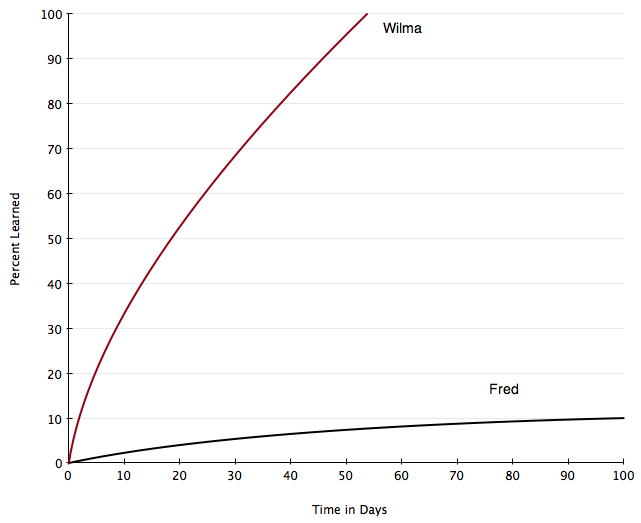
Now that we have both axes labeled, we can plot a couple of learning curves as seen below:

Learning_curve

On this graph we have two curves, named Wilma and Fred, to represent the divergent trajectories of two different violin players. I’ve exaggerated their learning paths to clarify the point. I think it safe to agree that Wilma has made more significant progress than Fred, as she has achieved the fictional 100% learned status for the violin. Fred, after toiling for 100 days, has mastered roughly 10% of the instrument. But note that the “steep” learning curve is the one that Wilma rode to the top, whereas the shallow learning curve is one that Fred is meandering on. Yet Fred had told Barney that the instrument has a steep learning curve?!


As you can see, a steep learning curve demonstrates that you’re mastering the endeavour in question rapidly. For those lamenting a difficult task, you’re actually riding a shallow learning curve, not a steep one. This misconception is a worm that has bore itself into the sinews of conversation, but next time you’ll be appropriately armed to extract it.


It should also be noted, for the record, that this lesson about the learning curve has… a steep learning curve. And that’s a good thing.